You’ve been injured in an accident. Maybe it was a serious collision on the highway, or a chain-reaction crash at an intersection, or someone ran a red light and turned your life upside down. Now you’re facing medical bills, missed work, insurance companies asking for recorded statements, and the overwhelming question: do I need a lawyer?
If you’ve started looking, you’ve probably seen Morgan & Morgan’s ads everywhere on TV, billboards, online. “For the People” sounds reassuring when you’re hurt and confused. But you’ve also heard that local attorneys offer something different: personal attention, deep roots in your community, and a relationship that feels less corporate.
So which path makes more sense for your case? The answer isn’t as simple as “bigger is always better” or “local is always more caring.” What matters is understanding what each type of firm actually delivers, where they excel, and where they fall short. Let’s look at the real differences so you can make a decision based on your specific situation, not just advertising.
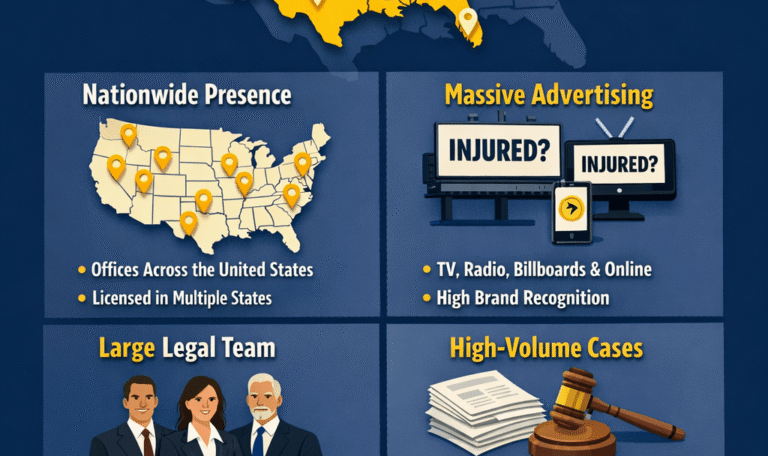 How Large National Firms Like Morgan & Morgan Operate
Morgan & Morgan is structured like a law firm franchise. They have offices across dozens of states, employ hundreds of attorneys, and handle thousands of cases simultaneously. That scale creates a specific type of practice model.
When you call Morgan & Morgan, you’re typically routed to an intake team that evaluates your case based on established criteria. If your case meets their thresholds usually involving clear liability, significant injuries, and insurance coverage worth pursuing you’ll be signed up. Your file then gets assigned to an attorney, often someone you didn’t meet during the initial consultation.
This isn’t necessarily a problem. Large firms have systems designed to handle volume efficiently. Paralegals manage documentation, intake specialists gather initial information, and attorneys step in for negotiations, depositions, and court appearances. For many straightforward cases, this assembly-line approach works reasonably well.
But here’s what accident victims often don’t expect: you may rarely speak directly to an attorney. Much of your communication will be with support staff. When decisions need to be made whether to accept a settlement offer, how to respond to a defense attorney’s argument, or whether to proceed to trial you might get a call from an attorney you’ve never met who’s reviewing your file for the first time that day.
For some people, that’s perfectly fine. They want the firm to handle everything, and they’re comfortable communicating with a team. For others, especially those dealing with life-altering injuries or complex liability disputes, the lack of a consistent attorney relationship becomes frustrating.
What Local Personal Injury Attorneys Bring to the Table
A local personal injury attorney typically runs a smaller practice maybe a solo practitioner, or a firm with two to ten attorneys. Cases don’t get lost in a national database. When you call, you’re often speaking directly to the attorney who will handle your case, or at minimum to someone who works closely with them every day.
This model has distinct advantages. Your attorney knows the local court system, the judges, and the defense attorneys they’ll be negotiating against. They understand how juries in your county tend to view certain types of cases. They’ve probably handled claims involving the same insurance adjusters who are now handling yours, and they know which adjusters negotiate fairly and which ones stonewall until you’re ready to file suit.
One experienced auto accident attorney put it this way: “When I walk into a courthouse in my county, I know the clerk, I know the mediator, and I know the tendencies of the judge assigned to the case. That familiarity doesn’t guarantee a better outcome, but it eliminates surprises and lets me give my client realistic expectations about what’s going to happen.”
That institutional knowledge matters more than most people realize. A local attorney can tell you, “Judge Smith hates when defense attorneys drag out discovery if they’re stalling, we can push for a trial date and they’ll likely settle.” Or, “This insurance company always lowballs the first offer, but they settle fairly once we file suit and take a few depositions.” Those insights come from years of practicing in the same community, and they inform strategy in ways that a national firm’s playbook can’t.
Case Selection: Who Gets Accepted and Why
Both large firms and local attorneys are selective about which cases they take, but their criteria often differ.
Morgan & Morgan can afford to be selective because they have volume. They’re looking for cases where the damages are significant, the liability is relatively clear, and the defendant has insurance or assets worth pursuing. A rear-end collision with $100,000 in medical bills and clear liability? They’ll take it. A complicated intersection accident with disputed liability and $15,000 in damages? Probably not.
This isn’t a criticism it’s economics. Contingency fee firms need cases where the potential recovery justifies the time investment. Large firms have overhead costs that make smaller cases financially unviable.
Local attorneys often have more flexibility. Because their overhead is lower and they’re not managing thousands of simultaneous cases, they can take on matters that larger firms would decline. A case worth $30,000 might not make sense for Morgan & Morgan, but a local attorney can handle it profitably while still giving it proper attention.
There’s another factor: personal connection. A local attorney might take a case because they know the client, or because the client was referred by someone they trust, or simply because they believe in the claim even if the damages aren’t massive. That doesn’t happen in a corporate intake system designed around metrics and case value algorithms.
ReadMore : How Long Does a Morgan & Morgan Personal Injury Case Take? Timelines Explained
Resources and Trial Capability: Where Size Matters
Here’s where large firms have an undeniable advantage: resources.
Taking a serious injury case to trial is expensive. You need expert witnesses accident reconstructionists who charge $5,000 or more just to review the case, medical experts who cost $500 an hour, economists to calculate future lost earnings. You need to pay for depositions, court reporters, exhibit preparation, and potentially travel if witnesses are out of state. A complex case heading to trial can easily require $50,000 or more in advanced costs.
Morgan & Morgan can absorb those costs without blinking. They have the infrastructure, the capital, and the volume of cases to spread that risk across their practice. If your case requires significant litigation, knowing your firm won’t run out of money halfway through is reassuring.
Smaller firms face real constraints here. A solo practitioner or small partnership might handle dozens of cases, but they can’t afford to advance $50,000 on every file. If your case is truly complicated and will require extensive expert testimony and litigation, you need to know your attorney has the financial ability to see it through.
That said, most personal injury cases settle before trial. According to various industry studies, somewhere between 90% and 95% of personal injury claims resolve through settlement. For the vast majority of accident victims, the resource question never becomes a limiting factor. A capable local attorney with a solid track record can negotiate a fair settlement without needing a war chest.
Communication and Client Relationships
This is where the most significant difference emerges, and it’s often the factor that matters most to people dealing with serious injuries.
In a large firm, your case is one of thousands. The attorney assigned to your file is managing dozens of other cases simultaneously. You might go weeks without hearing from anyone unless you initiate contact. When you do reach out, you’ll likely speak to a paralegal who has to look up your file to remember where things stand.
Again, this isn’t inherently bad. Many people prefer minimal contact they want the firm to handle things and only call when there’s a settlement offer to discuss. But if you’re someone who needs regular updates, or if your case has unique complications that require ongoing strategic discussions, the lack of direct access to an attorney can be frustrating.
Local attorneys typically offer more direct communication. You have your attorney’s cell phone number. You can schedule an in-person meeting without navigating a corporate phone tree. When you call, the person who answers knows your name and your case.
One attorney described the difference this way: “My clients can text me if they have a question. I might not respond immediately, but they know I’ll get back to them the same day. That level of access isn’t possible when you’re managing a thousand cases across multiple states.”
This matters particularly when settlement offers come in. Large firms sometimes present offers with a recommendation but limited explanation. You’re left wondering: is this actually a fair offer, or are they just trying to close the file? A local attorney who knows your case inside and out can walk you through exactly why they’re recommending acceptance or rejection, what the risks of continued litigation are, and what they genuinely believe your case is worth.
ReadMore : When Should You Hire a Car Crash Lawyer After an Accident?
Geographic Knowledge and Local Reputation
If your accident happened in Miami and you hire a Miami-based local attorney, they practice in that environment every day. They know which hospitals the insurance companies trust for medical evaluations. They know which body shops provide reliable repair estimates. They understand local traffic patterns that might be relevant to proving liability.
More importantly, they have a reputation to protect in that specific community. A local attorney who treats clients poorly or settles cases too quickly will lose referrals and damage their practice. That built-in accountability doesn’t exist in the same way for a national firm where you’re unlikely to ever speak to the same attorney twice.
Defense attorneys and insurance adjusters also respond differently based on who they’re negotiating against. An adjuster who knows a particular local attorney takes cases to trial and wins will approach settlement discussions more seriously than they might with a firm they perceive as a settlement mill.
Large firms have their own form of reputation, of course. Morgan & Morgan’s name recognition can sometimes work in your favor during settlement negotiations. Insurance companies know they have the resources to litigate aggressively if necessary. But that’s a corporate reputation, not a personal one, and it doesn’t always translate to better results for individual clients.
Fee Structures and Cost Transparency
Both large firms and local attorneys typically work on contingency, meaning they take a percentage of your recovery rather than charging hourly fees. The standard range is 33% to 40%, depending on whether the case settles before or after litigation begins.
Here’s where things can differ: negotiability and transparency.
Large firms like Morgan & Morgan have standardized fee agreements. Everyone pays the same percentage based on firm policy. There’s no room for negotiation, and the terms are what they are. For straightforward cases, this creates clarity you know exactly what to expect.
Local attorneys may offer more flexibility. If your case is particularly strong and likely to settle quickly, some will agree to a lower percentage. If you’re a referral from a trusted source, or if there’s a personal connection, they might structure fees more favorably. This isn’t universal, but it’s more common in smaller practices where attorneys have discretion over their own agreements.
The bigger difference often comes in how costs are explained. In both scenarios, case costs expert fees, medical records, filing fees are separate from attorney fees. But local attorneys are more likely to walk you through a detailed breakdown of what those costs might be and how they’ll affect your net recovery. Large firms sometimes provide less detailed explanations until settlement, leaving clients surprised by how much is deducted for costs.
ReadMore: What Does a Car Crash Lawyer Do? A Step-by-Step Breakdown of Your Case
When a Large Firm Makes More Sense
Certain situations genuinely favor hiring a large national firm:
Complex cases with catastrophic injuries: If you’ve suffered a traumatic brain injury, spinal cord damage, or other life altering harm, you need a firm with the resources to hire top-tier medical experts and litigate aggressively. Large firms can handle these cases without financial strain.
Multi-state accidents: If you were injured in a state where you don’t live, or if the accident involves parties from multiple jurisdictions, a firm with offices nationwide can navigate those complications more smoothly than a local attorney practicing outside their home state.
Cases against large corporations: If you’re suing a trucking company, a rideshare platform, or another corporate defendant with deep pockets and aggressive defense lawyers, you want a firm that can match their resources and isn’t intimidated by drawn-out litigation.
You prefer a hands-off approach: If you’d rather let the firm handle everything and only want to be contacted when there’s something specific requiring your input, the structured, team-based approach of a large firm might suit your preferences.
When a Local Attorney Is the Better Choice
Other scenarios clearly favor a local attorney:
Moderate-value cases with clear liability: If your damages fall in the range where a large firm might not take the case, but it’s still worth pursuing say, $20,000 to $75,000 a local attorney can give it proper attention.
You value direct communication: If you want a personal relationship with the attorney handling your case, regular updates, and the ability to reach them directly when questions arise, a smaller practice offers that access.
Local knowledge matters: Cases involving disputed liability, local traffic laws, or specific understanding of your community benefit from an attorney who practices there daily.
Your case involves unique circumstances: If your situation doesn’t fit neatly into a standard template maybe you have pre-existing injuries, or the accident involved unusual factors you want an attorney who will take the time to understand those nuances rather than processing your file through a standardized system.
You want to support local businesses: Some people simply prefer working with local professionals who are part of their community. That’s a legitimate factor in your decision.
Red Flags to Watch for (Regardless of Firm Size)
Whether you’re considering Morgan & Morgan or a local attorney, certain warning signs should make you pause:
Pressure to sign immediately: Any attorney large firm or small who pressures you to sign a retainer agreement before you’ve had time to think or consult with family is operating unethically.
Guarantees about outcomes: No honest attorney will promise a specific settlement amount or guarantee you’ll win. Anyone making those promises is either inexperienced or dishonest.
Unwillingness to answer questions: If an attorney won’t explain their fee structure, how costs are handled, or who will actually be working on your case, that’s a problem regardless of firm size.
Too many cases: If a local attorney tells you they’re handling 200 active cases, they don’t have time to give yours proper attention. Similarly, if a large firm’s attorney seems to have no idea who you are when you finally speak with them, that’s a red flag about how they manage caseloads.
Poor communication from the start: If you’re already having trouble getting callbacks or answers during the consultation process, it’s not going to improve after you sign up.
Making Your Decision: Questions to Ask
Before you choose any attorney, ask these questions and pay attention to how they respond:
“Who will actually handle my case day-to-day?”
You need to know whether you’ll be working with the attorney you’re meeting, a team, or someone else entirely.
“How often will I receive updates, and who will I speak with when I have questions?”
This clarifies communication expectations from the start.
“How many cases do you (or the assigned attorney) currently have?”
This helps you gauge how much attention your case will receive.
“What percentage of your cases go to trial, and what’s your track record?”
This reveals whether the attorney actually litigates or just settles everything.
“Can you explain your fee structure, including how costs are handled?”
Any attorney should be able to explain this clearly without hesitation.
“What do you think my case is worth, and what factors will affect that?”
Their answer tells you whether they’re giving thoughtful analysis or just inflating expectations to sign you up.
“What happens if I’m unhappy with how my case is being handled?”
You have the right to fire your attorney, but understanding the process ahead of time prevents future complications.
The Bottom Line: It Depends on Your Priorities
There’s no universal answer to whether Morgan & Morgan or a local attorney is better for your case. It depends entirely on what you’re dealing with and what you value most.
If your case involves catastrophic injuries, significant damages, and the potential for extended litigation, a large firm’s resources and infrastructure make sense. If you’re dealing with a moderate-value claim and want personal attention from an attorney who knows your community, a local lawyer is probably the better fit.
Don’t choose based on advertising or name recognition alone. Meet with attorneys from both categories if you can. Pay attention to how they communicate, whether they seem genuinely interested in your situation, and whether their answers to your questions feel honest and detailed.
The right attorney isn’t necessarily the one with the biggest office or the most commercials. It’s the one who understands your case, has the resources to handle it properly, and makes you feel confident that your interests come first. Trust your instincts, ask direct questions, and choose the option that gives you the most clarity and peace of mind during an already difficult time.
ReadMore: Car Crash Lawyer Cost Explained: Fees, Settlements, and What You Actually Pay